Making clinical AI trustworthy through knowledge architecture & reasoning
“Olivia” Z. Milgrom, MD, MPH
Combining the best of LLMs and symbolic semantics to produce explainable clinical knowledge — at the speed of AI, with the rigor of curated expert knowledge.
I design and ship knowledge architecture and evaluation frameworks at enterprise scale — catching where AI drifts from domain truth, working across healthcare stakeholders, engineering teams, and end users.
Neuro-Symbolic AI for HealthcareKnowledge Graphs & Formal ReasoningEnterprise-grade ProductionExplainable & auditable AI PipelineNational Library of Medicine Informatics Fellowship TrainedClinical AI Safety
Problems that keep showing up when AI meets high-stakes domains
LLMs are powerful, but in high-stakes areas like healthcare, sounding right isn’t the same as being right —
and even when AI can explain itself, that doesn’t mean experts can verify it.
When Retrieval Misleads
The model finds a concept that looks like a match based on word overlap, but means something clinically different. Keyword similarity masks semantic divergence.
Semantic Drift
The answer starts in the right clinical territory but gradually shifts meaning through plausible-sounding steps — ending somewhere subtly wrong.
The model generates clinical codes, classifications, or relationships that don't exist. Without a formal knowledge base to check against, fabrications are invisible.
The Explainability Gap
AI can show a reasoning path, but domain experts need to verify, explore, compare, and generate hypotheses — not just read explanations. That’s what it takes to keep the AI accountable.
Logical Rule Misapplication
Even when what the system reasons over is correct — the knowledge holds, the source is right, the concept didn’t drift — how it reasons over that knowledge still cannot be compromised.
Clinical medicine’s conditional logic is among the densest of any domain:
IF / AND / OR
UNLESS / EXCEPT
Satisfying more than N out of M criteria
When a clinical AI cannot hold that logic, it doesn’t fail — it shortcuts.
Technical Approach
Bidirectional grounding — reasoning built in, not patched on
Designing systems where clinical knowledge and AI inform each other continuously — not as a pipeline, but as a layered architecture.
Human
↔
LLM
semantic interpreter + hypothesis generator
↔
Knowledge Layers
How the domain is defined· Ontology
How things relate· Knowledge Graph
What must hold· Rules & Constraints
↔
Reasoning
knowledge computation + verification
↔
Human
visual reasoning + hypothesis exploration
01
Layered Knowledge Architecture
‘RAG is dead’ — when voices across the industry say this, what they mean is that store-and-retrieve was never enough.
Even knowledge graphs — now the fastest-rising trusted context layer for GenAI in enterprise AI (according to Gartner) — are only one layer. I specialize in the deeper conceptual infrastructure where clinical logic can be proven, not just looked up.
02
Hybrid Retrieval + Reasoning Loop
Most AI systems stop at retrieval; others still rely on black-box machine learning. Neither LLM nor symbolic reasoning alone is sufficient. I design hybrid approaches where clinical knowledge and AI inform each other continuously.
03
Automatic Evaluation at Scale
Every answer traced back to its contexts and original intent — built to be:
ConfigurableAuditableExplainableEnterprise-scale
04
Visual Reasoning & Sensemaking
Explainability, taken even to its visual form.
A paradigm shift in how auditing happens — empowering domain experts to go from open-ended investigation to focused hypotheses.
Interview: Why Knowledge Management Should Be the #2 Topic After AI
When the industry was just beginning to grapple with LLMs in healthcare — on why high-quality clinical knowledge management is the foundation for reliable AI models.
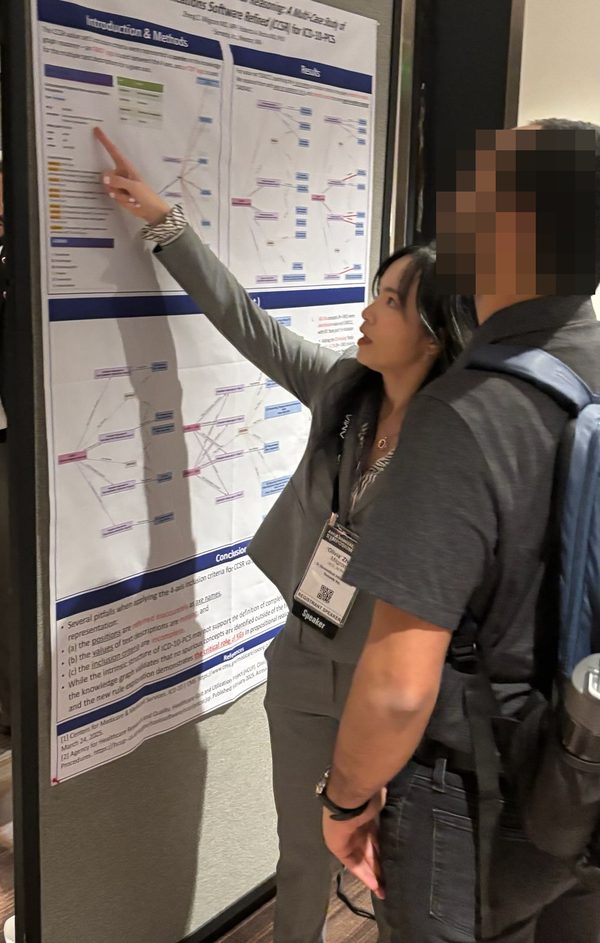
American Medical Informatics Association (AMIA)Nov 2025Atlanta, GAPoster Presentation at Annual Symposium
Knowledge Graph for Propositional Reasoning: A Multi-Case Study of CCSR (Clinical Classifications Software Refined) for ICD-10-PCS (Procedure Coding System)
When classification rules (inclusion criteria) quietly break, how do you find out? Using knowledge graph reasoning to surface three types of logical inconsistency — the kind conventional methods miss.
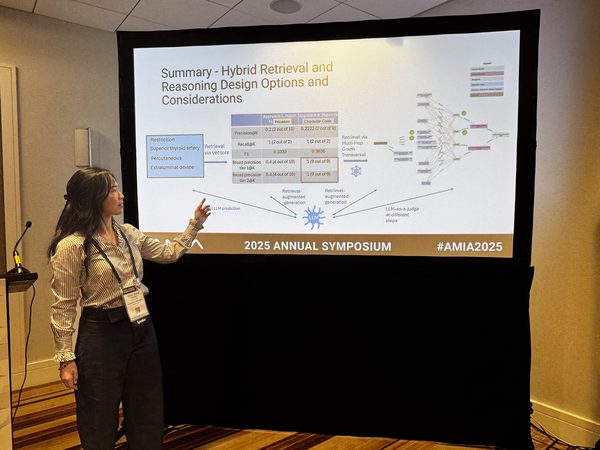
American Medical Informatics Association (AMIA)Nov 2025Atlanta, GAPodium Presentation at Annual Symposium
Hybrid Retrieval and Reasoning to Predict Procedure Codes from Key Terms Using Knowledge Graphs and LLMs
Exploring six hybrid approaches that combine knowledge graph traversal with LLM capabilities — showing when structured retrieval before generation outperforms LLMs alone.
MediumDec 20254 min read
A ‘Semantic Drift’ Perfect Storm: How Medical AI Chatbots Get It Wrong
A real-world case study dissecting how a medical AI chatbot confidently gave wrong dosing advice for dialysis patients.
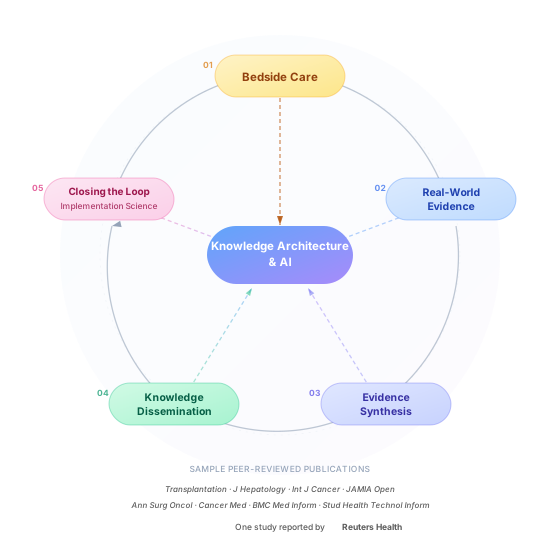
The full evidence-based medicine cycle — lived, practiced, and now built into AI
Beyond the Work
Growing minds — including my own
My Unconventional Path
Growing up, I was drawn to two things — art and math.
Drawing, calligraphy, stage performance… and the satisfaction of a proof that holds without a crack.
My math teacher told me I was the best student he’d ever had, and he believed I could make a difference if I stayed with STEM.
But I wanted something totally practical — something that would make a tangible difference in people’s lives. I chose medicine.
While navigating the unsustainable realities of medicine, I had my aha moment: encountering the work of Yuval Noah Harari, I saw how technology reshapes humanity and realized the power of combining clinical knowledge with AI, before large language models arrived.
AI fails not for lack of data, but for lack of understanding.
Philosophy — the questions it asks, and the ontological frameworks it clarifies — is the key to fixing it.
Teaching kids to tell fake from true — in art and in AI, the same question applies.
I bring that question to elementary school kids: can you tell what’s real
and what’s AI?
🤖
AI Dance Room
Real or Fake Animals? You Guess!
🐾 🐷 🕊 🐾 🐷
🔍 You Are AI Detectives!
▶ Play ‘I Need to Zone Out (and Dance Now)’ — Real or Fake?
👀Round 10:00 – 0:30Real or fake animals?
👀Round 20:30 – 1:00Real or fake animals?
👀Round 31:00 – 1:30Real or fake animals?
🎤 Bonus: Who Sang This Song?
A) Olivia Milgrom - me
D) The principal from your elementary school
B) AI / Robot
E) Rumi from K-pop Demon Hunter
C) Taylor Swift
F) The pelican/bird in the video
“I Need to Zone Out (and Dance Now)”
I made this song and music video — and played it
at an elementary school festival where kids tried the guessing game above.
▶ Press play the music video and try the guessing game yourself!
Robot Dance Performance
If you have guessed correctly, a real robot would dance to the song —
showing kids how AI, music, and robotics connect.
Get in Touch
Let’s talk about trustworthy clinical AI
Whether you're working on clinical AI, exploring how knowledge representation
can improve LLM reliability, or just curious about this space —
I'm always happy to connect and exchange ideas.